
ESI: An Embodied Self‑Improvement Flywheel for LLM–VLA Agents
ESI turns a pretrained LLM and a pretrained VLA into one coordinated robot agent, by learning from their own interaction.
Agent + VLA
Ahead of all published LLM+Model embodied agents, without generating task-specific control code.1
The problem
Why connecting an LLM and a VLA is not enough
A reasoning model and an action model can each be capable and still fail together. The failures sit at the interface between them.
Intent gap
The LLM chooses a goal. The VLA does something familiar instead.
Handoff gap
The LLM repairs the motion and gives control back. The VLA cannot continue from there.
More LLM control fixes the episode. It does not fix the next one. ESI treats these interactions as training data.
Results
Higher task success with less LLM control
The evaluation uses ten of the most challenging tasks in RoboDojo.1 Against a matched baseline on the same layouts, ESI completes more tasks while the LLM takes direct control far less often. It also exceeds every published reference in the table below on both metrics.3
Against published references
All results are in simulation: RoboDojo, with a dual-arm ARX X5 robot. The first three columns are ESI and its two components evaluated alone. The other columns are entries on the RoboDojo leaderboard for the same task names. Type is the entry's own category on the leaderboard; GO-3 Nano Preview, for example, is listed as Agent + WAM.1
Ten tasks in one model
The most challenging RoboDojo tasks, all run by one LLM and one VLA.4
Same outcome, less help
LLM control where the baseline leaned on it most
Paired cases ranked by how much of the episode the baseline ran under direct LLM control; only the cases where that share is highest are shown. Each line is one episode, scaled to its own length.
How it works
One loop that improves three components
Inside an episode, the LLM and the VLA plan, propose, review and act. Across rounds, the same record updates the prompts that guide the LLM, the skill interface that carries its intent, and the VLA that executes it. The LLM's weights stay fixed.5
How a guidance update moves through the system
Illustrative exampleAfter a round, a proposed rule must cite the failures behind it, a recovery that was seen to work, and counterexamples that limit it.
Recorded cases
Proposed rule
The path of an accepted rule
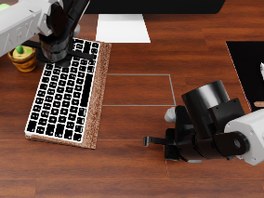

When repeated supported keyboard pushes fail to improve alignment, distinguish missed edge engagement from engagement producing the wrong motion.
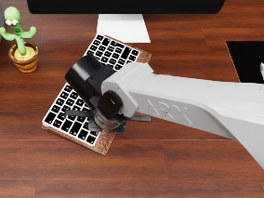

If the fingers cross the border while the keyboard stays still, clear and adjust the approach height to engage an accessible edge. If the keyboard moves but mostly translates while the required rotation stalls, change the contact location rather than extending the same push. Use the resulting keyboard motion to choose further corrections.
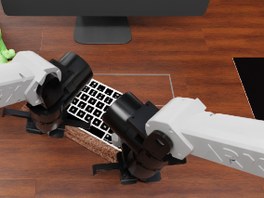

Preserve productive [VLA] pushes, including differential pushing; neither a rejected approach nor remaining offset alone requires changing contact.
Automatic checks
- Two or more independent cases
- A working recovery and counterexamples
- Within 180 words
- An identifier of its own
Independent review
A separate conversation reads the cited decisions and images itself. It approves, rejects, or asks for a closed-loop test.
Next round's prompt
learned_keyboard_contact_response When repeated supported keyboard pushes fail to improve alignment, …Published as one hash-pinned bundle. The next collection round loads exactly that file.
The frames and the rule come from the system's analysis of round-one Organize table episodes; the bracketed word replaces a term from the record. The right-hand column illustrates the path of a rule that passes. The reported results use fixed guidance.5
Shared interface
The LLM's instruction is also the VLA's training label
The subtask the LLM sends online is the same language the VLA is trained on offline. Build one and see exactly what the VLA receives.
Build a subtask
The catalog. One shared vocabulary for one VLA; each entry describes an operation, and none is a separate controller. Pick one to build it above.
Data pipeline
How interaction records become training data
Follow one failed episode from the simulator into the training set. Each step is a design choice, not a separate ablation.
Component study
What each component contributes
Roll back one adapted component at a time, on 100 matched cases.7
By task
Ten cases per task and configuration. Darker cells are higher.
Unseen task
A task outside the training data
Complete the equation was never used in flywheel collection or post-training. ESI solves four of the five test layouts, the baseline two, and LLM-executed steps fall from 99.0 to 43.6 per episode.8
Intent following
One scene, three requested orders
One scene, one target arrangement. Only the requested pad order changes.8
ESI completes all three orders. The baseline completes two.
Why it matters
A path from better reasoning to better robot execution
The LLM works twice. It helps finish the task now, and its decisions and corrections become supervision for the policy. A stronger reasoning model is therefore a second way to improve the robot, next to more robot experience. This is a direction the framework opens, not a measured result.
- The ten tasks are chosen to be among the most challenging in RoboDojo: the suite starts from the GPT-as-Policy ten-task suite and replaces several easier tasks with more demanding ones. Twenty scheduled cases each. Score and success rate are task means with tasks weighted equally. Reference values come from the RoboDojo leaderboard for the same task names, using each entry's reported case set. The strongest reference Score is 48.51 (WorldScape-R²SI) and the strongest reference success rate is 38.60% (HexaShell-Preview); ESI exceeds them by 13.52 Score and 10.81 points. Code-based methods generate task-specific control code; ESI does not.
- Environment steps executed under direct LLM control, averaged per episode. An LLM decision executes at least one such step.
- The matched baseline is GPT-as-Policy with the original RoboDojo-adapted VLA, task-only policy conditioning and baseline decision guidance. Both agents use GPT-6-Astra with the same environment code, layouts, scene seeds, motion executor and native step budgets. Three native-invalid layouts are excluded from both, leaving 197 paired cases. The comparison measures the two deployed systems as a whole.
- For each task, the ESI episode is the ESI success whose LLM-executed steps are the median among that task's ESI successes (the lower middle one when even); Fill pen holder has one, Sweep blocks and Organize table two each. The baseline panel shows the matched baseline episode on the same layout and split. All ten ESI episodes share one LLM and one VLA checkpoint. Row numbers cover all of the task's paired cases.
- The three-round configuration behind the reported numbers updates the VLA each round with a fixed prompt and skill catalog. The automatic prompt and skill update mechanisms are integrated in the released system.
- Of the candidate training-window starts in each round's 200 collected episodes, 47.9%, 48.6% and 49.7% come from episodes that ended in failure. This counts window starts, not independent trajectories or sampling probability.
- Ten tasks with ten matched cases each. The ESI reference is the matched subset of the main evaluation; the rollback runs use a later evaluation implementation, so each configuration is reported as an absolute result. Three-hour timeouts count as non-success.
- In the transfer and order studies, both agents use subtask feedforward and action review; the baseline has the initial policy, free-form subtasks and no added task guidance. The equation task was excluded from flywheel collection and post-training. The five layouts were chosen for follow-up after preliminary testing on five others. Each order was run once per agent in one fixed scene, and order adherence was checked by video inspection.
Technical report, November 15, 2026
ESI: An Embodied Self-Improvement Flywheel for LLM–VLA Agents
University of Science and Technology of China, Tsinghua Shenzhen International Graduate School, ZERITH Robotics